
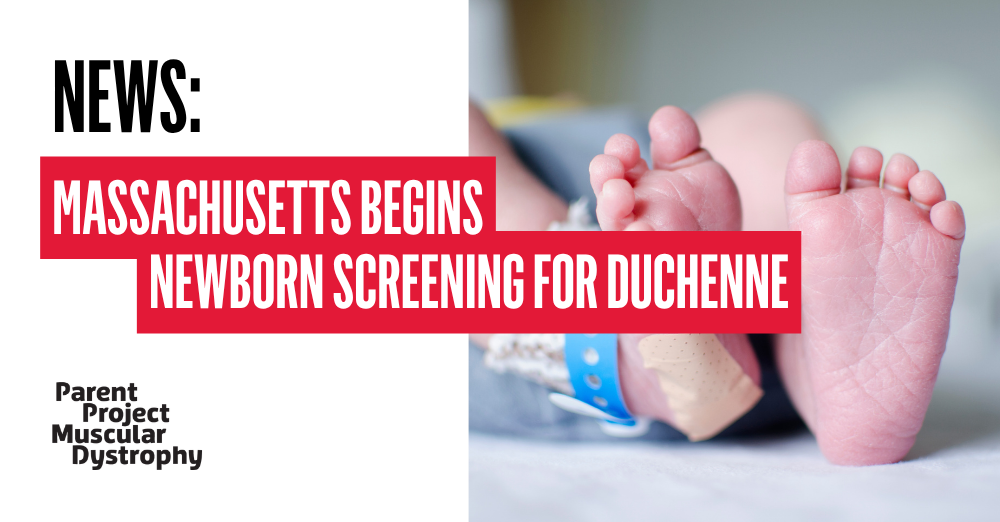

Duchenne Newborn Screening Action Center
Newborn screening aims to prevent families from experiencing diagnostic delays and ensure that every family receives timely, supportive, accurate resources at the time of diagnosis. Right now, the drug pipeline is full of promising new therapies, and because of the progressive nature of Duchenne and Becker, it’s imperative that people diagnosed are offered therapeutic interventions as early as possible to ensure the best possible outcomes. For over a decade, PPMD has spearheaded efforts to establish nationwide newborn screening for Duchenne to address this need.
Click on the map below to learn about each state’s Duchenne newborn screening status and find out how you can get involved in advocating for newborn screening in your state.
Newborn Screening by State
- Approved & Implemented Screening
- Approved, Not Yet Screening
- Legislation/Committee Pending
- No Activity
Become a PPMD Advocate
If you are interested in supporting state or federal efforts for Duchenne newborn screening, sign up to become a PPMD Advocate.
Sign up form

Get Involved
Duchenne has been added to the Recommended Uniform Screening Panel! Help us reach all states
In 2022, PPMD submitted a nomination package to add Duchenne to the Recommended Uniform Screening Panel (RUSP), the federal recommendation for which conditions should be included in nationwide newborn screening. Through collaboration, education, and advocacy, Duchenne was added to the RUSP in December 2025. This is a landmark milestone for early diagnosis and care, and now we need help from the community to bring Duchenne newborn screening to every state.
FAMILIES: If you are interested in sharing your story or contacting your state elected officials, please fill out this interest form.
CLINICIANS: If you are interested in getting involved to support our Duchenne newborn screening efforts, please fill out this interest form.
Newborn Screening Advocacy Toolkit
Download resources to support Duchenne newborn screening efforts
Fast Facts About Newborn Screening for Duchenne
Downloadable resource about the impact of Duchenne newborn screening.
>
Consensus Statement Championing Duchenne Newborn Screening
60+ leading experts have authored a consensus statement in support of implementing Duchenne newborn screening.
>
White Paper: Newborn Screening for Duchenne
Informational white paper written by World Duchenne Organization.
>
Positive Newborn Screen Resources
The Duchenne journey is complex, but PPMD is here for you. If you have just received a positive screening for Duchenne or Becker, resources are available.
FAQs
Duchenne muscular dystrophy and Becker muscular dystrophy are among a spectrum of muscle diseases known as “dystrophinopathies.” The word dystrophinopathy comes from the fact that these conditions are caused by genetic variants in a gene called DMD, which provides instructions to make a protein called dystrophin. The progression of symptoms for dystrophinopathies is variable, ranging from early onset symptoms and quicker progression (Duchenne muscular dystrophy) to later onset symptoms with slower or more variable progression (Becker muscular dystrophy). Carriers of dystrophinopathies may also experience a range of symptoms.
Without functional dystrophin protein, muscles become damaged and are unable to repair themselves properly. This genetic disorder can be passed from parent to child, or it can result from a random spontaneous genetic mutation. Most cases of Duchenne occur in families with no previous history. Duchenne progresses differently for every person, but it ultimately results in loss of muscle function.
Approximately 360 babies with Duchenne are born each year in the United States, and evidence of muscle damage is present in infancy. Without newborn screening, families typically notice symptoms of Duchenne in their child by age 2, but most of those families will not receive a diagnosis until age 5. This delay is even longer in families who are marginalized by race or income inequality. By age 5, children with Duchenne have significant and irreversible muscle damage.
There are now eight FDA-approved treatments for Duchenne, four of which are approved for use in infancy. Newborn screening can eliminate the delay in diagnosis and provide families the opportunity for treatment years earlier, when children have more functional muscle tissue remaining.
PPMD’s mission and work extends to all of the dystrophinopathies, including those diagnosed with Duchenne, Becker, and carriers. On our website, we sometimes use the term Duchenne to refer to any condition caused by variants in the DMD gene. However, the information in this answer is specific to Duchenne. Newborn screening for dystrophinopathy typically focuses on trying to identify babies with Duchenne alone, because it is the most severe condition in the dystrophinopathy spectrum with the earliest onset. However, it is possible for newborn screening techniques to identify someone with Becker or who is a dystrophinopathy carrier.
The first-tier screen for Duchenne evaluates CK-MM, the muscle isoform (muscle version) of a marker called creatine kinase. CK-MM is a biomarker of muscle damage and is highly elevated in newborns and children with Duchenne. If a baby’s CK-MM is high and stays high, confirmatory testing—DNA sequencing of the dystrophin gene, DMD—is required. The presence of a pathogenic (disease-causing) variant in DMD confirms the diagnosis. In some states, both the screening and confirmatory test can be performed on the standard NBS dried blood spots, with no additional blood draw required. Sometimes, confirmatory genetic testing requires a new blood draw or saliva sample.
The RUSP is the federal recommendation for which conditions all babies in the United States should be screened for at birth. Duchenne is on the RUSP.
Parent Project Muscular Dystrophy led the nomination of Duchenne to the RUSP in 2022 in collaboration with its co-nominator, the Muscular Dystrophy Association. In 2025, less than a month from making a decision, the Health Resources and Services Administration (HRSA) committee that reviews condition nominations to make recommendations to the Department of Health and Human Services (HHS) Secretary was dissolved. PPMD and other advocates worked with HRSA and HHS to help the department complete and publish the Duchenne evidence review. A public workshop was held to review the evidence with input from the lead of the evidence review, Duchenne experts, and members of the dissolved committee. HRSA published a request for public comment regarding the addition of Duchenne to the RUSP, and all of these pieces of evidence were taken into consideration as HRSA considered whether to recommend the addition to the HHS Secretary.
In December 2025, HHS reported that HRSA recommended adding Duchenne to the RUSP and the Health Secretary formally approved its addition on December 16, 2025.
The RUSP is only a recommendation for which conditions all states should include in their programs, and many states do not currently screen for every condition on the RUSP. Although some states have RUSP-alignment laws that define a timeline in which they must review or add a new RUSP condition, most states have an undefined timeline to review Duchenne for addition, ensure that the necessary resources are available, and work toward implementation.
Whether RUSP-aligned or not, it typically takes several years for a state to add a new condition to their program and begin screening. It is vital that states consider the addition of Duchenne now, before more of our children’s time and muscle is lost.
An expert group of Duchenne clinicians developed and published clinical guidelines for care following a newborn screening diagnosis. After newborn screening, families consult with pediatric neuromuscular care teams to discuss the most appropriate treatment course for each child. They have the potential to initiate therapies such as exon skipping, gene therapy, and steroids years earlier than they would if diagnosed through traditional pathways. They may be able to enroll in clinical trials.
Establishing care in infancy also enables referrals to early intervention services such as speech, behavioral, physical, and occupational therapy. Newborn screening diagnosis has benefits for the family, including identifying at-risk family members, like carrier mothers who are at risk for cardiomyopathy and siblings who may be carriers or affected. Many families also report using this information in future family planning.