
WHAT IS DUCHENNE/BECKER MUSCULAR DYSTROPHY?
Duchenne (“doo-shen”) muscular dystrophy (Duchenne) is the most common muscular dystrophy in children. It is a progressive disorder that causes muscles to become weaker over time until it affects the whole body.
Duchenne muscular dystrophy is one of a spectrum of muscle diseases known as dystrophinopathies that can range from mild to severe in presentation. Dystrophinopathies occur when the dystrophin protein (found in the body’s muscle cells) has an altered structure or function, or is entirely absent from the body’s muscle cells. Becker muscular dystrophy is also a dystrophinopathy with many similarities to Duchenne. And while Becker can be variable, depending on when symptoms first present, typically the symptoms are milder in progression compared to Duchenne. PPMD’s work extends to both Duchenne and Becker, but for simplicity we primarily refer to Duchenne. You can think of Duchenne and Becker as different ends of the spectrum of dystrophinopathies.
Duchenne is a genetic disorder caused by a change in the DNA (or gene) that codes for dystrophin. Since the dystrophin gene is found on the X-chromosome, it primarily affects males. Females are typically known as carriers because they have one copy of the changed gene and one copy of the functioning gene. Carrier females often do not have outward symptoms of dytrophinopathy. However, some carrier females can present with varying ranges of physical symptoms and are considered to have dystrophinopathy as well, but are usually termed manifesting carriers.
While there is yet no cure for Duchenne, and many parents are told that there is no hope and little help, Parent Project Muscular Dystrophy exists to offer the support and resources parents may not find anywhere else. There is hope — with more than 40 companies currently working on treatments for Duchenne and more than 20 drugs in clinical trial, there are tremendous reasons to hope. Knowledge is power, and informed and timely care can help people living with Duchenne live longer and with a much greater quality of life than ever before.
HOW COMMON IS DUCHENNE?
Duchenne is not contagious. About one out of every 5,000 boys has Duchenne, and about 20,000 babies worldwide are born with it each year. Duchenne mostly affects boys and reaches across all races and cultures. Parent Project Muscular Dystrophy (PPMD) estimates that there are about 15,000 young men, as well as a few young women, living with Duchenne today in the United States. Although genetic disorders are usually passed down from a parent to a child, Duchenne muscular dystrophy can occur even if no one in your family has had it before.
In the US, a rare disease is defined as a condition that affects fewer than 200,000 people. Although Duchenne is considered rare, there is a huge active community at your fingertips working to end Duchenne.
WHAT CAUSES THE SYMPTOMS OF DUCHENNE?
Duchenne is caused by mutations in the gene that encodes for a muscle protein called dystrophin. Dystrophin is in every single muscle cell in our bodies. Dystrophin acts as the glue that holds muscles together and the “shock absorber” that allows muscles to contract and relax without being damaged.
Without dystrophin, muscles are not able to function or repair themselves properly. As muscles are used for normal day-to-day activity, tiny tears are created in the muscle cells, which cause creatine kinase (CK) to leak out of the cells and results in high levels in the blood. Because there is no dystrophin, the muscles can’t repair themselves by making new muscle, so the damaged muscle is replaced by fat and scar tissue. This causes the person with Duchenne loses muscle function and strength.
Duchenne is a condition that progresses very slowly over time. The first symptoms are often subtle, such as delays in crawling walking and/or speech. Parents may or may not notice these delays, and primary care providers often attribute these delays to something else.
Clear symptoms typically develop between the ages of 2 and 5 years, which is typically when the diagnosis is made. Muscle weakness follows a proximal to distal pattern, meaning muscles near the trunk, such as the hips and shoulders, will be affected before those of the arms and legs. This is why you may notice your child having difficulty walking, running, or climbing stairs. When asked to get off the floor, your child will often use the Gower’s Maneuver, or use their arms to “walk” up their legs to a standing position. They may also appear clumsy and fall a lot, and their calves may appear enlarged or overdeveloped (called pseudohypertrophy, which is replacement of the calf muscle with fat and scar tissues). This is when a primary care provider will likely order a creatine kinase (CK) blood test to check for muscular dystrophy.
WHY DOES MY CHILD HAVE DUCHENNE?
Duchenne is a genetic disorder, which means it is caused by a change in the DNA sequence of a gene. Genes house the instructions for how to make proteins, and proteins are the building blocks of the body. In Duchenne, there is a change (often called a mutation or variant), in the gene that codes for the dystrophin protein, so the dystrophin protein is not made properly.
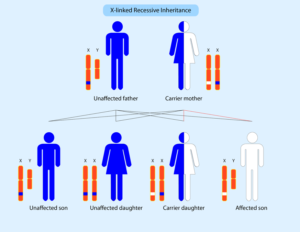
Duchenne is a “X-linked” disorder, which means the dystrophin gene is on the X-chromosome. It may be helpful to review some basic genetics. Every person has 23 pairs of chromosomes, which contain all of their genes and determine their sex. One of each pair of chromosomes are inherited from their mother, and the other from their father. Females always have two X-chromosomes, so mothers always pass down an X-chromosome to their child. Males have one X-chromosome, and one Y-chromosome, so fathers can pass down either an X or Y-chromosome, which will ultimately determine the sex of the baby. Boys always inherit their X-chromosome from their mother, and their Y-chromosome from their father, whereas girls inherit two X-chromosomes, one from each parent.
Since a boy only has one X-chromosome, if that chromosome contains the Duchenne gene mutation, he will have Duchenne. However, since girls have two X-chromosomes, if one of them has the Duchenne gene mutation, they are usually not affected because they have a second back-up copy of the gene on their other X-chromosome. Females with one X-chromosome with the Duchenne gene mutation are known as carriers of Duchenne. Carriers have the ability to pass on the mutated Duchenne gene to their children.
Since DUCHENNE is genetic, was it inherited from me?
You may have someone in your family who has or had Duchenne. As a genetic disorder, Duchenne can be passed down from a parent to a child, so it could already be in your family’s genes. Many mothers who carry the Duchenne gene often do not know they are carriers. Approximately two-thirds (2/3) of newly diagnosed boys with Duchenne causes have inherited the gene from their carrier mother.
Duchenne can also occur even if no one in your family has had it before. The Duchenne gene is very large, which increases the incidence of mutation during pregnancy. This is why approximately one-third (1/3) of Duchenne cases are caused by a spontaneous mutation, or a new change in the DNA that is not inherited from the mother. The only way to determine if a child with Duchenne has inherited the mutation or has a new mutation is for the mother to have carrier testing.
GENETIC TESTING
Genetic testing (also known as DNA testing) is the process of examining a person’s DNA. In Duchenne, the dystrophin gene is analyzed for changes, or mutation, that would prevent the gene from working properly. Genetic testing is typically performed on a blood or saliva sample.
Genetic testing is always necessary and should be offered to every family when a diagnosis of Duchenne is suspected. Different types of genetic tests are able to provide specific information about the change or mutation in the DNA. It is important to know the specific gene change or mutation for many reasons. To learn more about genetic testing, and how genetic counseling can help your family, please click here.
Creatine kinase (CK) levels can be confusing to understand. PPMD brought together neuromuscular specialists to explain what CK testing is, how it can help diagnose dystrophinopathy, why a CK level might be high even in people without dystrophinopathy, how CK levels can fluctuate as individuals age, and what an elevated result can (and can’t) tell you.
Interpreting CK Levels in the Diagnosis of Duchenne
Video 1 Question Group – An Introduction to Creatine Kinase (CK) Levels
- What is creatine kinase?
Creatine kinase, sometimes referred to CK for short, is an enzyme found in many different tissues in our body. The highest amounts are found in our muscles and our heart. An enzyme is something that helps speed up chemical reactions in the body. CK is one of those enzymes, and its main job is to help provide energy to our muscle cells. - Why is creatine kinase (CK) elevated for Duchenne and Becker muscular dystrophy?
A small amount of CK is normally present in our blood, and we can measure it with a simple blood test. When CK levels are higher than normal, it often means the muscles are under stress or have been damaged. In Duchenne and Becker muscular dystrophy, the body lacks a protein called dystrophin, which helps keep muscle cells strong and stable. You can think of the cell membrane as the outer covering of a muscle cell. It controls what goes in and out. Without enough dystrophin, the membrane becomes fragile, and CK can leak out of the muscle cells into the blood, leading to higher CK levels on a test. - Is CK elevated for every person with Duchenne or Becker?
CK is very sensitive for Duchenne and Becker, meaning it’s usually elevated in almost everyone with these conditions. However, it’s not a perfect test. CK levels can be influenced by many factors, including the age at which the test is done. In general, a normal CK level in a young child is quite reassuring and makes Duchenne less likely. Most children with Duchenne will have a high CK level early in childhood. - Are there reasons why CK could be elevated in a person without muscular dystrophy?
There are many reasons a CK level can be elevated. Some common causes include muscle injury or stress, inflammation in the muscles, certain medications, or even severe illness. Strenuous exercise can also raise CK levels. Additionally, there are other muscle disorders, besides Duchenne and Becker, where CK may also be elevated. - Do people with Duchenne and Becker have elevated CK every day of their life?
CK levels can fluctuate somewhat over time, both in the short term and long term. In people with Duchenne, CK levels are usually highest in early childhood and then gradually decrease as a person gets older. This drop tends to follow the loss of motor function. As muscles weaken, there is less healthy muscle tissue, and over time that muscle is replaced by fat and scar tissue. Because of this, there’s less CK released into the blood, which is why CK levels tend to go down with age. - Sometimes test reports will reference things like CPK, CK-MM, or CK total – what is important for families to understand about the differences between these? Are they different from each other?
CPK stands for creatine phosphokinase, and it’s essentially the same thing as CK, or creatine kinase. The terms are used interchangeably, though CPK refers a bit more specifically to the chemical reaction the enzyme helps with. CK actually exists in a few different forms, sometimes called isoforms. Different tissues in the body make different amounts of each form. For example, CK-MM is mostly found in skeletal muscle, CK-MB is found in the heart, and CK-BB is found in the brain. When we measure a total CK, that number represents the sum of all these isoforms. If any one of them is elevated, it contributes to a higher total CK. Looking at which isoform is elevated can help determine where the CK is coming from, whether it’s the muscles, the heart, or the brain.
Video 2 Question Group: Interpreting CK Levels in the Clinic
- How do you use CK level results in your clinic?
CK levels are really a first step in looking for any signs of muscle breakdown in a patient. At an initial clinic visit, if there are signs of muscle weakness or developmental delays, it’s common to order a CK test. The results can point to a number of possible conditions related to muscle damage. It’s a simple, inexpensive screening tool that can be done easily in most clinics. - If a person has an elevated CK result, is there a threshold for which you can tell if they will be affected by Duchenne versus Becker muscular dystrophy?
CK levels can help point us in the direction of a possible muscular dystrophy, but other tests are needed to make a specific diagnosis. Think of CK as a screening tool. It can raise suspicion for Duchenne, Becker, or other types of muscular dystrophy, but additional testing, usually genetic, is needed to confirm what is going on. A normal CK level also does not rule out a muscle disorder completely. Some congenital myopathies or other muscle conditions can have normal CK levels. Most muscular dystrophies, however, will show an elevated CK. So it is a helpful first step in the diagnostic process, but it is just the starting point. - Can a child with multiple normal CK levels go on to develop Duchenne muscular dystrophy in the future? What about Becker muscular dystrophy?
It would be very unusual for a child with multiple normal CK levels to develop Duchenne in the future. While CK is not very specific for the type of muscular dystrophy, it is usually very high in patients who do have muscular dystrophy. Patients who have had normal CK levels, especially on multiple occasions, are very unlikely to develop muscular dystrophy in the future. - Will carriers have high CK levels? Can a CK level confirm if someone is a carrier or not?
CK is not a reliable way to determine who is a carrier of a DMD gene mutation. Some female carriers may have mildly elevated CK levels, but many carriers have normal CK levels, so a normal result does not rule out carrier status. In cases where a female with a known DMD mutation has a high CK level, it could suggest she is a manifesting carrier, and specialists may pay closer attention to potential symptoms. However, CK alone cannot determine the presence of heart or other symptoms in carriers. Identifying subtle symptoms in carriers requires a detailed evaluation by a specialist, not just a CK test. - If a person has a genetic test report that says they have an abnormal DMD gene, due to a pathogenic variant, and their CK is normal, does that eliminate the possibility that they will develop symptoms in the future?
If a person has a normal CK and a genetic test identifying a variant, it generally rules out Duchenne or Becker muscular dystrophy, especially if CK has been normal on multiple occasions. Some variants in the DMD gene may be benign, so interpreting the results usually requires guidance from a neuromuscular specialist or a genetic counselor familiar with the DMD gene. - What advice do you have for someone who has a CK result they don’t understand?
The best approach is to ask your doctor to help interpret the results. If your primary care doctor ordered the test, start there. They may know the answer or may need to consult a specialist. You can also take the question directly to a neuromuscular specialist. CK levels can be tricky to interpret, so getting input from a specialist can be very beneficial. - Is there anything else you’d like to make sure patients and healthcare providers know about CK level?
The most important thing is simply to check CK levels, especially in any child with motor delays. Checking CK early and, if needed, checking it regularly can help identify muscular dystrophy sooner. A very high CK does not automatically predict what will happen in the future. High CK can have many causes, and even when it reflects muscular dystrophy, outcomes are not set in stone. Advances in care and new treatments continue to change what is possible, so the future remains uncertain. The key is early evaluation and monitoring, not assuming results dictate the long-term course.
Video 3 Question Group: CK Levels and Newborn Screening
- Why is CK level the measurement that will be used for Newborn screening for Duchenne?
There are a few important considerations when choosing a marker for newborn screening. Newborn screening is done using a dried blood spot, which involves taking a small amount of blood from a baby’s heel and placing it on a card that is sent to the state screening lab. The marker needs to be stable and accurate in this dried form and also feasible to test on a very large scale, since nearly all babies in the United States undergo newborn screening. The marker should also reliably identify babies who are affected while excluding those who are not. Even though babies with Duchenne do not show symptoms at birth, their CK is elevated, making it a very effective marker for detecting the condition through newborn screening. - What could cause a false positive newborn screen for Duchenne?
There are several reasons a newborn screen for Duchenne might be false positive, mainly because the test uses CK rather than genetic testing. While CK is very sensitive for Duchenne, it is not 100% specific. Common causes of false positives include birth trauma, infection during the neonatal period, and other muscle disorders. CK levels are also naturally higher during the first 24 to 48 hours after birth, since the physical process of birth, even a C-section, can be demanding for newborns. The timing of the screen and whether it is repeated can help determine whether an elevated result is more or less likely to be a false positive. - Do we think NBS will detect 100% of people with Duchenne? If not, what could lead to a false negative?
Ideally, the goal of newborn screening is to detect every case of Duchenne. However, no screening test is perfect. There can be variability in lab cutoffs, which determine how high CK must be to trigger a positive screen. Some factors can elevate CK, while others can lower it. Prematurity and very low birth weight are known examples. If the CK measurement falls below the cutoff, it is possible the baby could be missed by newborn screening. This is uncommon, but it has been observed in previous pilot programs. Finally, while very rare, there is always a small risk of technical or human error. - Will newborn screening detect people with Becker muscular dystrophy or people who are carriers?
Unfortunately, the answer here is not straightforward. For both people with Becker muscular dystrophy and DMD carriers, CK elevation at birth is more variable than in Duchenne. However, pilot studies and newborn screening programs that have been implemented so far have successfully detected both. - What should someone do if they get a call about a positive CK screen for Duchenne on newborn screening?
First and foremost, it’s important to try to remain calm. CK is a screening test and by itself is not diagnostic. The evaluation pathway can vary depending on your state. It might involve repeating the test, since CK is typically highest in the first few days of life when the newborn screen is usually done and often normalizes afterward. Alternatively, the next step could be a referral to a genetic or neuromuscular specialist. For parents or family members, it is important to be selective about the resources you use for information. For healthcare providers, it’s recommended to review your state’s screening protocol and discuss next steps with neuromuscular colleagues. - Is there anything else you’d like to make sure patients and healthcare providers know about CK level?
It’s important to remember that newborn screening programs are state-dependent. You can’t assume your state screens for Duchenne just because other states do. Even if your state does include Duchenne in its newborn screening, any child presenting with developmental delays should still have a CK test. CK is a valuable screening tool both in the newborn period and later in life, so it should always be considered when evaluating a child with developmental delays.